Choice-Based Narrative
with Michael Mateas, members of EIS, and collaborators

Making meaningful decisions
About choice-based narrative
A common motivation for interactive narrative creators is to give audiences meaningful choices. But a simple forking story requires a large amount of authoring very quickly, in order to cover all the possible outcomes. A common fix for this is to "collapse" forks into other narrative strands, but this can make it feel like player choice is being invalidated.
In EIS we both investigated the power of choice-based narrative and developed new design/technology approaches to make it more responsive and tractable.
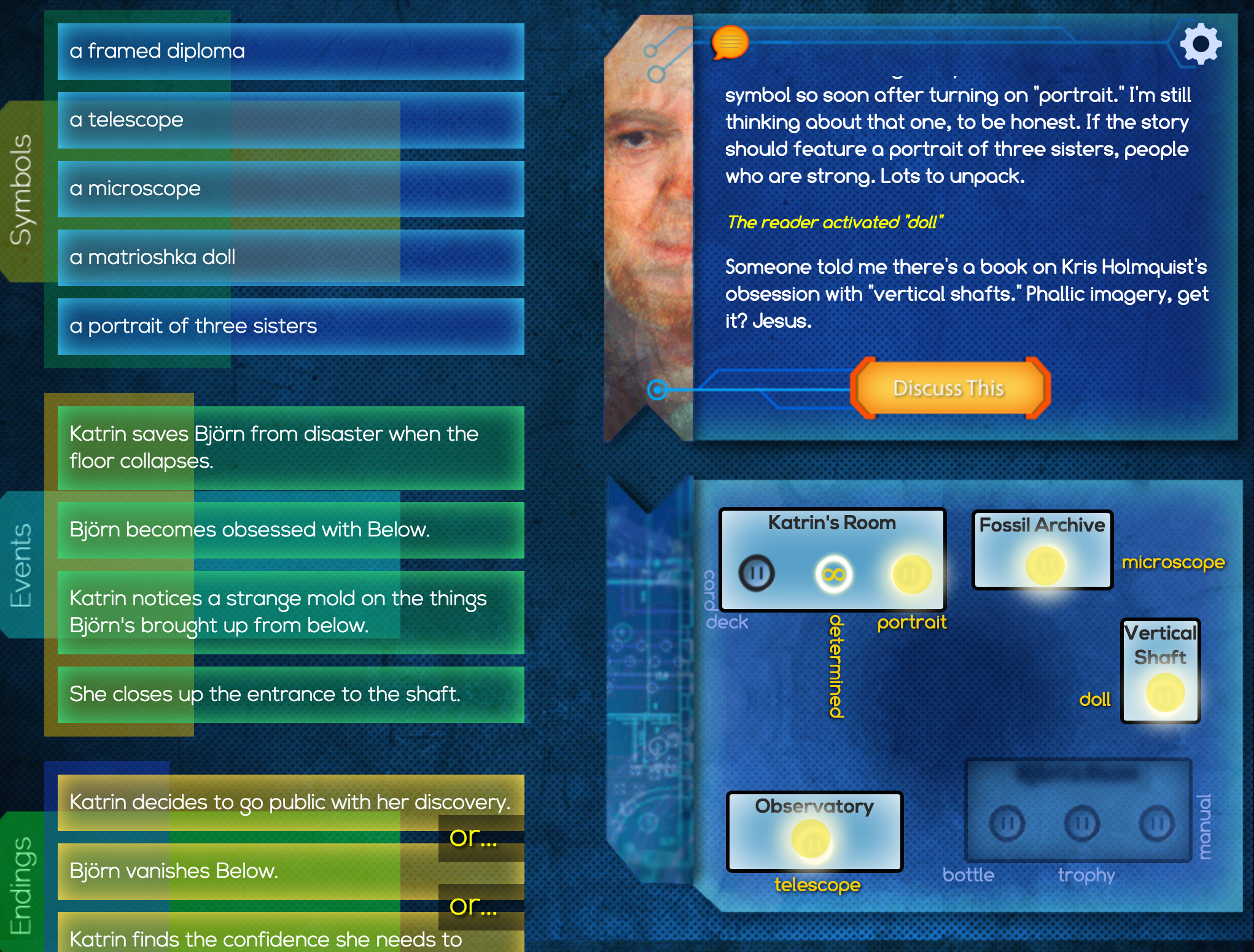
Our most developed project in the area was The Ice-Bound Concordance, led by EIS members Aaron A Reed and Jacob Garbe. This game's new approach to interactive narrative lets players work with an unusual character, an AI simulacrum of a dead author. Together they explore a vast number of possible combinations of events and themes that could complete the author's final manuscript, enabling choices within a generative story space to be the core gameplay.
During the game's development we published papers both about its novel approach and about the visualizations created to help the authors understand the degree of coverage available for different potential states of the story space. Upon release it was lauded by the games community, winning the "Story/World Design" award at IndieCade, winning the "Best Gameplay" award at Intel's university showcase, and being a featured finalist at both the Independent Games Festival and SXSW. Rock Paper Shotgun called it "one of the most ambitious projects I've ever seen," EuroGamer said it was "unmissable" and "brilliant," KillScreen called it "extraordinary," and Gamasutra called it a "masterfully layered" and "magisterial" game.
In parallel with the development of The Ice-Bound Concordance, we also began to explore the potential for choice-based narrative in learning. Many single-player games are effective at helping students learn about topics that are inherently systemic and relatively easily operationalized into game mechanics (e.g., economics, physics). In 2014 the UCSC Graduate Division approached us to ask about the possibility of a game to help people learn about a much less clear-cut set of topics: the ethics of responsible conduct of research. In 2015 EIS student Dietrich "Squinky" Squinkifer completed a prototype choice-based narrative game — Academical — in which players take turns occupying the perspectives of two different characters in the same interaction, generally one with greater power and one with less, reflecting the lived experience of graduate student researchers. This compelling prototype led to creation of a more developed version of the game in 2017-18, led by James Ryan and Nic Junius. Finally, in 2019 we teamed up with CM faculty member Eddie Melcer's lab to understand if the game was having the impact we hoped (given past interventions in ethics education had shown no effect — or even backfired) and further refine it toward release, with EIS efforts led by Max Kreminski. This work's published results show improved learning outcomes (compared to in-use web-based curricula), improved student attitudes toward the subject, and improved depth of moral reasoning. One of these publications was selected as an exceptional paper by FDG 2020.
We also began, in work led by EIS member Peter Mawhorter, to look at the fundamental audience experience of choice-based narrative through the idea of "choice poetics." This work seeks to account for the fact that choices aren't simply interruptions or plot forks. They are a way of shaping how the players understand and feel about the story. We used Answer Set Programming to encode theories of choice poetics and created a system (Dunyazad) that could generate narrative effects. We published the results at the International Conference on Computational Creativity and the Artificial Intelligence in Interactive Digital Entertainment conference, with the latter nominated for best paper.
While this work was promising, it did not generate result in full stories — ones that would be satisfying to an audience. So for our next step Garbe worked with Kreminski and Ben Samuel to generalize the approach taken in The Ice-Bound Concordance. The resulting system — StoryAssembler — uses forward state-space planning for assembling a library of "storylets" into a structure that enables the accomplishment of narrative goals (provided in on "story spec") while the storylets themselves are dynamically assembled and customized using HTN-style planning. The result is an ability to generate a choice-based narrative from different story specs with a limited content library — and a level of authorability that has shown success with undergraduate writers without prior technical training. Our publications include a system and authoring description that was nominated for best paper at the Foundations of Digital Games conference. We made an open-source release of StoryAssembler.
The work on Dunyazad and StoryAssembler also influenced, and was influenced by, two further strands of research on choice-based narrative. One was led by EIS student John T Murray and Raquel Robinson from Katherine Isbister's lab. It focused on studies of player experiences and game structures of the sort popularized by game studio Telltale. The other, led by Stacey Mason and outside collaborator Ceri Stagg — who worked together on technical research at Telltale while Mason was on leave — developed a Prolog-driven system for dynamically assembling choice-based narratives: Lume. Mason and Stagg's system served as the technical foundation for a commercial narrative-driven game that was unfortunately canceled before completion.
In addition, our collaboration with Melcer and his lab had a final act, with funding from the NSF. This led to the development of Shi Johnson-Bey's framework for creating social simulation-driven visual novel experiences in Unity: Anansi. It combines the ink narrative scripting language, a storylet architecture, and a social simulation that manages non-player character (NPC) schedules, emotions, personality traits, and relationships. Interactions with NPCs affect their feelings toward the player character and other NPCs. Additionally, NPCs can reason about their relationship with the player characters and respond to events that happen to other characters in their social circle.
Related links
Website for The Ice-Bound Concordance
A publication on Academical
A publication on Dunyazad
A publication on StoryAssembler and the project's GitHub
A publication on Murray and Robinson's work
A publication on Lume